Researchers Predict New Form of Quantum Matter: The Quantum Droplet
Researchers predict a new form of quantum matter that challenges conventional thinking.
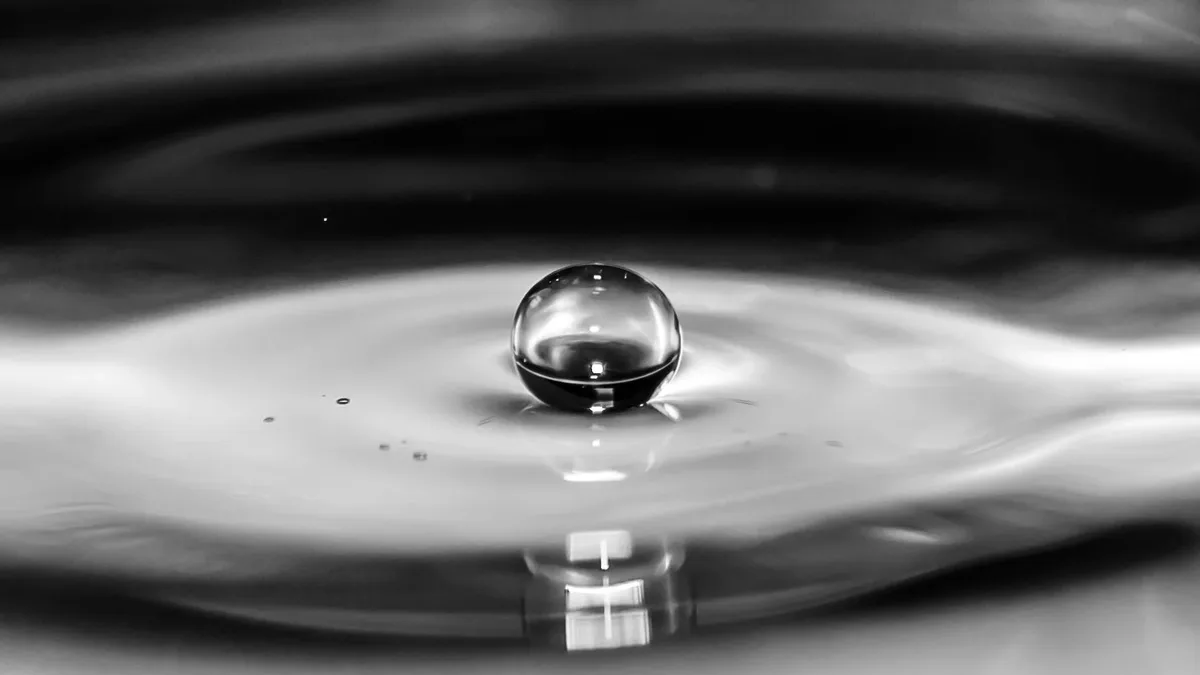
Researchers at Monash University have predicted an unusual new form of quantum matter, where two very different types of quantum particles - bosons and fermions - can combine to create stable, self-bound quantum droplets. According to the researchers, these droplets could overturn long-held assumptions about how ultracold particles behave.
The prediction, made by a team including Sam Foster, Associate Professor Jesper Levinsen and Professor Meera Parish, suggests that under the right conditions, bosons and fermions can balance each other perfectly to create a stable droplet that effectively holds itself together. This challenges previous theories, which considered such droplets unlikely to form in strongly interacting Bose-Fermi systems.
Quantum Mechanics
The stability of these quantum droplets comes from the unusual laws of quantum mechanics, where an attractive force pulling the particles together is precisely counteracted by pressure produced by the fermions, keeping the droplet from collapsing. This is fundamentally different from ordinary drops of liquid, which are held together by surface tension.
The researchers' new approach allows them to explore what happens when the interactions between particles become much stronger, which is where the most interesting physics emerges. According to Foster, the results create opportunities to investigate entirely new quantum states, and could improve scientists' understanding of quantum materials relevant to emerging technologies, including ultra-precise sensors and quantum computing.
Experimental Testing
The calculations indicate that these predicted droplets could be produced using ultracold atom experiments that already exist. This means researchers may have a realistic path toward testing the prediction experimentally. The team also found signs of additional unusual quantum behavior, with phenomena resembling the transition between a liquid and a gas.
Implications
The implications of this research could eventually reach beyond the field of atomic physics, according to Foster. Understanding how matter organizes itself under extreme quantum conditions gives us new tools for designing and controlling quantum systems. While this is fundamental research, discoveries like this often become the foundation for tomorrow's quantum technologies.
The study was published in Physical Review Letters, and was conducted in collaboration with researchers at Heidelberg University. The research provides a new theoretical framework for future experiments, and could reveal an unexpectedly rich world of new quantum phases. The paper, 'Quantum droplets in a resonant Bose-Fermi mixture', is available online, with a DOI of 10.1103/5pr6-5fmd.
Source: sciencedaily.com