Graphene antidot measures anyonic charge
Researchers have used a gate-defined antidot in bilayer graphene to measure the fractional charge of anyons, quasiparticles key to future topological
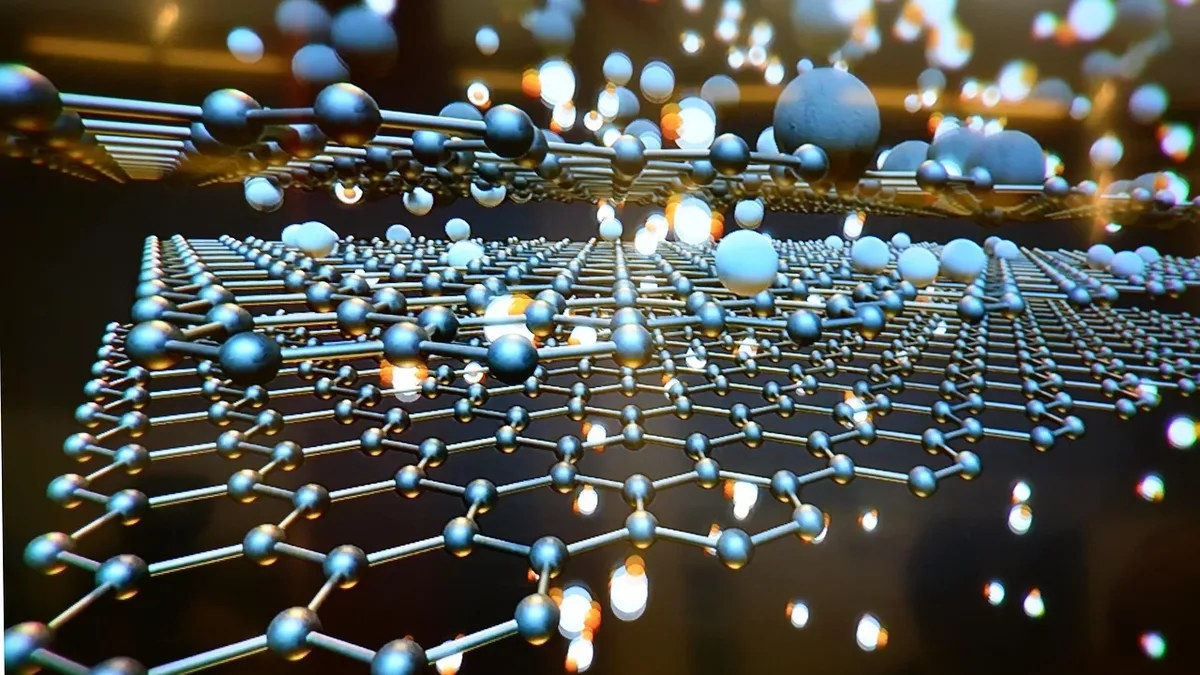
A new technique for measuring the fractional charge of anyons has been demonstrated in bilayer graphene. According to a report in Nature Physics, researchers used a gate-defined quantum Hall antidot to perform the measurements, a method that could aid in the development of topological quantum computers.
Anyons are exotic quasiparticles that emerge in two-dimensional systems under strong magnetic fields, a regime known as the fractional quantum Hall effect. Unlike electrons or photons, anyons possess fractional electric charge and exhibit unique statistical properties when exchanged. Their potential for fault-tolerant quantum computation has driven a long experimental quest to isolate and characterize them.
The Antidot Technique
The recent work centers on a device known as an antidot. This is a small, gate-defined region of depleted electrons within a larger conductive sheet. In the quantum Hall regime, edge states, one-dimensional channels that carry current, circumnavigate this obstacle. By tuning the voltage on the gate that defines the antidot, researchers can control the number of quasiparticles trapped within it. The measurement of current fluctuations, or shot noise, as particles tunnel on and off the antidot reveals their fundamental charge.
This approach was applied to bilayer graphene. The material's tunable electronic properties make it an ideal platform for exploring the fractional quantum Hall effect. The experiment specifically probed hole-conjugate states, where the observed fractional charge is determined by the parity of downstream integer edge modes.
Implications for Quantum Computing
The ability to reliably measure anyonic charge is a critical step toward manipulating these quasiparticles for computation. In topological quantum computing, information is encoded in the collective state of anyons and processed by braiding their world lines. This braiding is inherently protected from local noise, promising a route to robust quantum processors. The antidot method provides a direct electrical probe of the anyons' defining property, their fractional charge, within a solid-state device.
The research, detailed in Nature Physics, builds upon foundational work in the field. Key references include a 2008 review on non-Abelian anyons and topological quantum computation, and a 1995 paper that first reported the measurement of fractional charge in the fractional quantum Hall effect using resonant tunneling. The new graphene-based technique offers a precise and controllable system for further exploration.
Experimental progress continues to hinge on advanced material systems and nanofabrication. The successful use of bilayer graphene in this study highlights its growing importance in quantum transport experiments. The work provides a concrete tool for investigating the fundamental physics of anyons, moving closer to harnessing their unique properties for technology.