Graphene magnetophotoelectric effect enables infrared harvesting
A theoretical model proposes using electrostatic potential barriers and a magnetic field to separate electrons and holes in flat graphene, offering a path to efficient infrared solar cells.
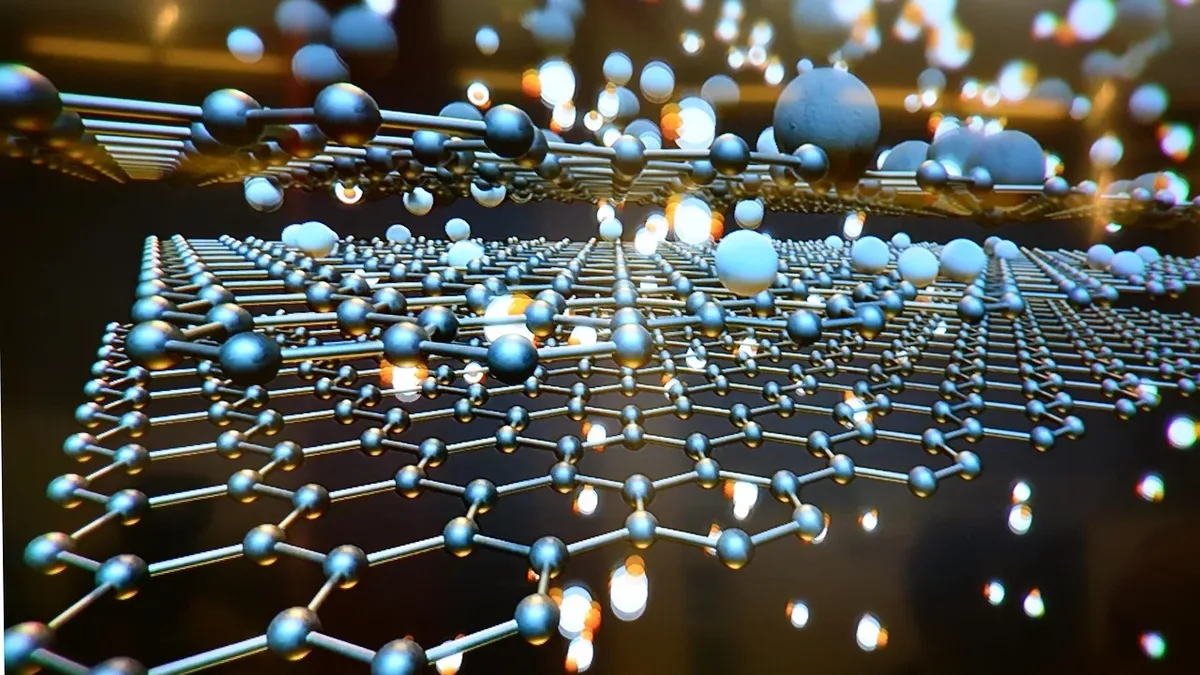
A new approach uses voltage-generated potential barriers and a magnetic field to separate electrons and holes in flat graphene for improved solar cell efficiency. The theoretical work, led by Prof. Ralf Schützhold, director of the Institute of Theoretical Physics at the Helmholtz-Zentrum Dresden-Rossendorf (HZDR), aims to overcome graphene's lack of a bandgap for infrared harvesting.
The method replaces the need to physically cut or fold graphene. Instead, narrow metal electrodes on an insulating layer above or below the graphene create electrical potential barriers. A perpendicular magnetic field causes the photogenerated electrons and holes to follow circular paths. These paths are then guided by the tailored potential barriers to opposite electrical contacts. The mechanism requires both the magnetic field and the electrostatic barriers; neither alone can produce the directional transport needed for a photocurrent.
Key design requirements for implementation
Theoretical conditions specify a 0.1-tesla magnetic field and micrometer-scale electrode spacing to achieve directional transport for infrared light. The electrode spacing must match the size of the circular trajectories, which depends on the magnetic field strength and the energy of the absorbed light. The potential barriers themselves must be sufficiently high and wide to prevent electrons from tunneling through directly.
| Requirement | Specification |
|---|---|
| Magnetic Field | 0.1 tesla |
| Electrode Spacing | Micrometer scale |
| Carrier Energy (for IR) | 0.1 eV |
Advantages over existing methods
This approach avoids the manufacturing challenges posed by edge defects in cut or folded graphene. Arrays of electrodes could extend the concept to larger graphene surfaces, making it scalable. It is particularly promising for harvesting infrared light, as graphene can absorb lower-energy photons that silicon solar cells cannot capture. The team estimates that existing technology, including permanent magnets and fine lithography, can achieve the required specifications.
A first experimental setup may involve a graphene 'sandwich' with insulating layers and fine metal strips, with voltages in the volt range applied to the electrodes. Prof. Schützhold noted that previous experiments with graphene edges confirmed the underlying theoretical prediction, yielding stronger-than-expected signals. "That's why we have to come up with a different mechanism," he said, referring to the need to move beyond edge-based designs.
Experimental readiness and validation
The research 2026, is grounded in confirmed theory. All required components are available, and HZDR plans to assemble and test the experimental setup. However, no physical device has been fabricated or tested, meaning there are no measured photocurrent or efficiency data yet.
Scattering from impurities and lattice vibrations could impede carrier transport if the mean free path is shorter than the cyclotron orbit size. Also, graphene's inherent light absorption is low, at approximately 2.3% per layer, though this can be increased by stacking multiple layers with transparent insulators and adding mirrors. A key feature is that the voltage at the electrodes can be dynamically adjusted, allowing the transport paths to be tuned for different light energies.
HZDR plans to assemble and test the experimental setup using a graphene 'sandwich' with insulating layers and fine metal strips, applying voltages in the volt range.