Gravitational Reconnection Discovery Reshapes Energy Transfer Understanding
Physicists have discovered gravitational reconnection, a process where space-time sheets break and reconnect to transfer energy into matter, drawing parallels to magnetic reconnection in plasmas.
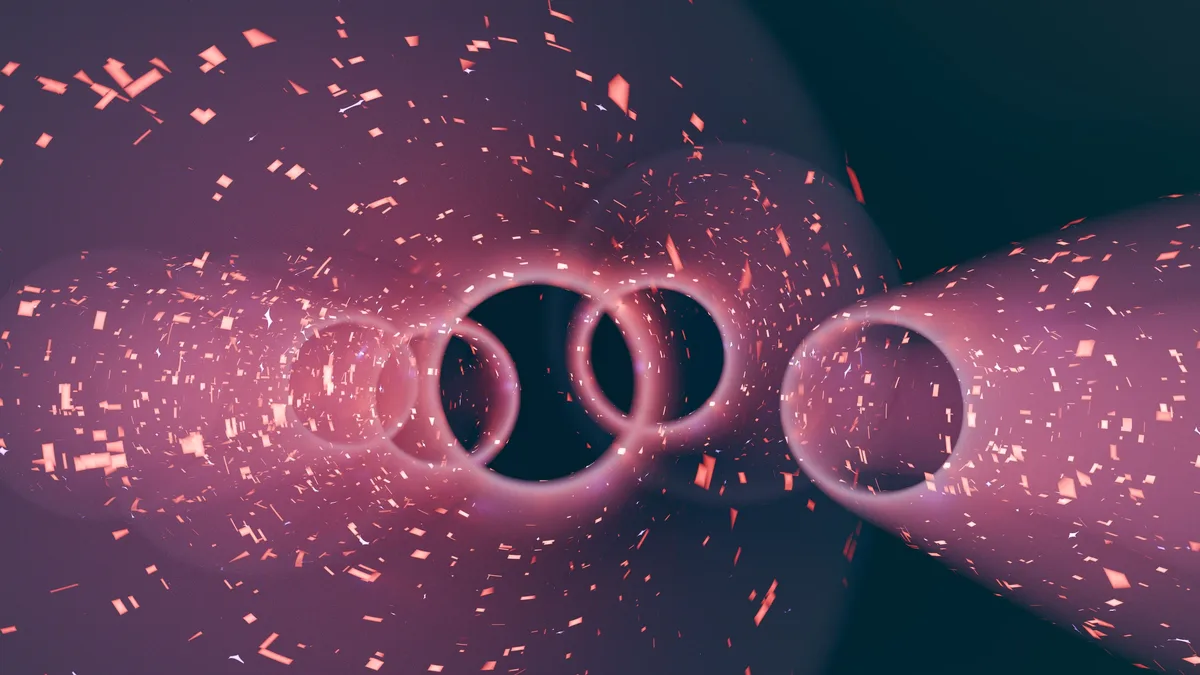
Scientists have uncovered a process where gravitational field structures break apart and reconnect, transferring energy into matter. More than a century after Einstein revolutionized gravity, researchers at Columbia University and Universidad Adolfo Ibáñez have identified this new phenomenon, called gravitational reconnection, by examining Einstein's equations from a different mathematical perspective.
Luca Comisso and Felipe A. Asenjo made the discovery. Their study, titled 'Reconnection of Gravitational Fields,' was published in Physical Review D. The research received support from the National Science Foundation and NASA.
Mathematical roots and parallels to magnetic reconnection
The discovery stems from a new mathematical formulation of Einstein's equations that reveals striking similarities with plasma physics. Einstein's equations contain hidden constraints on how space-time can evolve. Revealing these properties helps understand the fundamental rules governing gravitational reconnection.
Gravity operates differently because Einstein's theory describes space-time as a four-dimensional structure. "Because space-time is four-dimensional rather than three-dimensional, gravity involves something like field 'sheets' rather than field lines," explained Comisso. These sheets are mathematical structures, not physical surfaces. Adding one dimension to a line gives a plane; gravitational sheets can rearrange connections under appropriate conditions.
The breakthrough depends on a different, mathematically equivalent formulation of Einstein's equations. This formulation resembles equations used to study plasmas, making it useful for identifying patterns in space-time behavior. The phenomenon bears an unexpected resemblance to magnetic reconnection, which powers solar flares and releases energy from electrically charged gases.
"Magnetic reconnection is when these field lines, in some specific configuration, break and reattach in a different configuration," Comisso said. When the conditions preserving their connections break down, the sheets can reconnect. This allows energy to transfer from the gravitational field into matter.
Energy transfer and astrophysical implications
The reconnection process can produce extraordinarily powerful events, analogous to how magnetic reconnection releases energy. One of the most promising applications involves black hole collisions, where the newly identified rules could complement supercomputer simulations.
Gravitational waves are ripples in space-time that can be detected by instruments such as LIGO. Scientists rely on powerful computer simulations to predict the waves produced by these collisions. The newly identified constraints could help researchers determine how gravitational fields must behave without calculating every detail of their evolution.
It helps us predict some patterns of the space-time, Comisso said. Even without doing the full calculation, we know that space-time needs to behave in a certain way, that it needs to satisfy those constraints.
Their study builds on earlier research with Maricarmen A. Winkler that identified previously unrecognized constraints on how space-time can bend, stretch, and change over time. Researchers can use these underlying rules to determine which behaviors are physically possible.
Gravitational reconnection remains a theoretical discovery. Scientists have not yet established how the process operates in actual astrophysical environments or whether its effects can be observed. The next step is to investigate gravitational reconnection in specific situations, particularly when black holes merge.
Comisso hopes this research will eventually make it possible to estimate how much energy black hole mergers release. The goal is to determine whether gravitational reconnection produces recognizable signatures in gravitational wave signals. Investigation of gravitational reconnection in specific astrophysical situations, particularly during black hole mergers, is now underway.