Laser Cavity Technique Boosts NV Magnetometer Sensitivity 500-Fold
A German research team has developed a laser cavity method for nitrogen-vacancy diamond magnetometers, achieving 100% optical contrast and a sensitivity improvement of up to 500 times, enabling room-temperature vector magnetometry.
Physicists have unveiled a laser cavity method that replaces fluorescence measurements with near-infrared light amplification, achieving 100% optical contrast and a roughly 500-fold sensitivity improvement for nitrogen-vacancy magnetic sensors. The research, published in Nature Communications (DOI 10.1038/s41467-026-78386-z), was led by Florian Schall's team at the Fraunhofer Institute for Applied Solid State Physics in Germany.
Nitrogen-vacancy (NV) centres are atomic defects in diamond where a nitrogen atom and a vacancy replace adjacent carbon atoms. The unpaired electrons in these centres have spin states that are sensitive to magnetic fields. Conventional NV sensors probe these states by measuring the magnetic-field-dependent fluorescence emitted under green laser light, but this approach is limited by weak signals and optical contrasts of just a few percent.
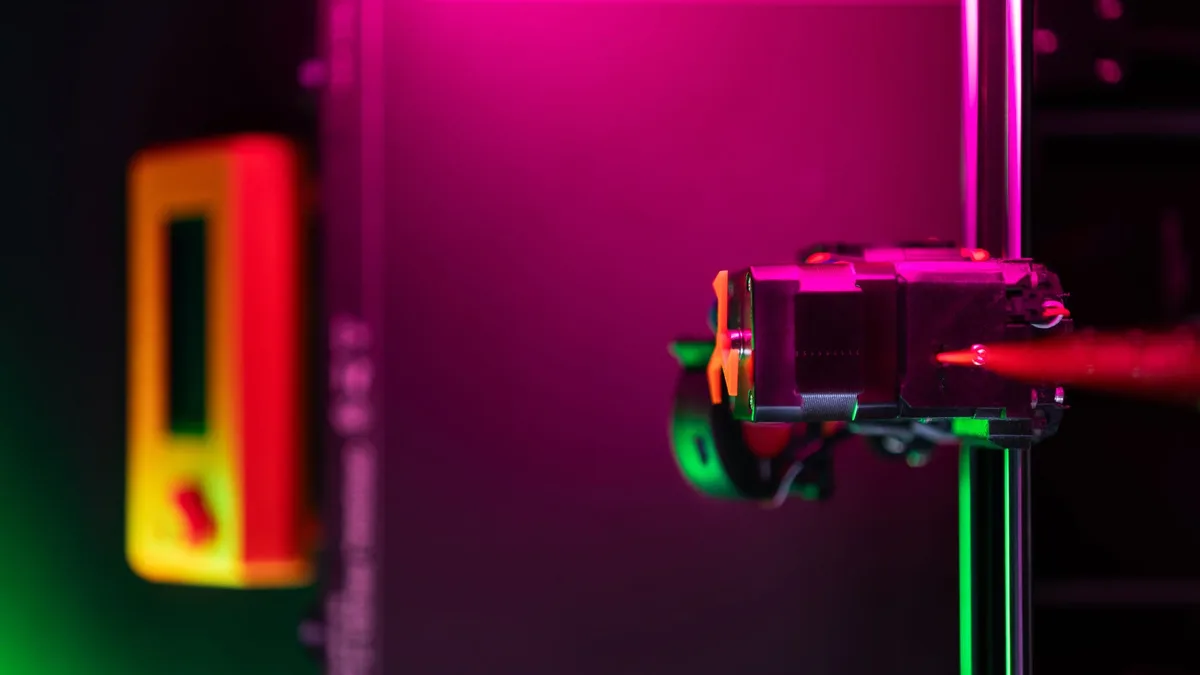
The new technique places an NV-doped diamond inside a laser cavity. A near-infrared laser, operating at a wavelength of 1042 nm, bounces light between mirrors, amplifying its intensity with each pass. This 1042 nm light is absorbed by NV centres when they are in an intermediate singlet state. By applying a fixed microwave frequency, the absorption changes based on the magnetic field strength, directly linking the laser's output intensity to the field. Operating the laser just above its minimum pump power means tiny absorption changes cause dramatic shifts in laser intensity.
When the microwave frequency matches the spin resonance, the laser shuts down entirely, delivering 100% optical contrast. When the frequency is off resonance, the laser produces a strong, coherent beam of over 50 mW. This approach eliminates the traditional trade-off between sensitivity and dynamic range.
Overcoming Fluorescence Limitations
The technique directly addresses the core limitations of fluorescence-based NV sensing. In standard methods, a green laser excites electrons, which then relax and emit a visible fluorescence signal. Applying microwaves can flip electron spins, and sweeping the microwave frequency reveals a dip in fluorescence at the resonant frequency, which shifts with external magnetic fields via the Zeeman effect. The new laser cavity method bypasses this weak fluorescence readout altogether by measuring infrared absorption in the NV intermediate singlet state, where no visible light is emitted.
Key Performance Advancements
The sensor's performance marks a significant leap forward, combining several key metrics that were previously difficult to achieve simultaneously.
| Metric | Achievement |
|---|---|
| Optical Contrast | 100% |
| Sensitivity Improvement vs. Fluorescence | Up to 500-fold (factor of 590 cited) |
| Sensitivity per Vector Component | Below 400 fT/√Hz |
| Output Power | Over 50 mW |
| Operating Temperature | Room temperature |
| Measurement Type | Full vector magnetometry |
The sensitivity, below 400 femtotesla per root hertz for each component of the magnetic-field vector, places the sensor in the ultra-sensitive regime required for detecting biomagnetic signals. Florian Schall noted a key capability: "It also enabled vector magnetometry, the determination of all three components of the magnetic-field vector, rather than just its magnitude or a single component."
The work provides experimental support for the theoretical relationship between optical contrast and sensitivity, showing that sensitivity improves more than linearly as contrast approaches 100 percent. The theoretical model for this magnetic-field-dependent laser system was first developed a decade ago by Dr. Jan Jeske. The research consortium included members from Fraunhofer IAF, Twenty-One Semiconductors GmbH, College of Staten Island (CUNY), the National Institutes for Quantum Science and Technology in Japan, and RMIT University in Australia, and was part of the NeuroQ project funded by the German Federal Ministry of Research, Technology and Space.
The sensor enables applications in medical diagnostics for detecting heart, muscle, and brain signals, as well as in navigation and resource exploration.