Quantum simulator replicates string-breaking
A 13-ion trapped-ion quantum simulator modeled string breaking, a process analogous to quark dynamics and particle formation in the early universe.
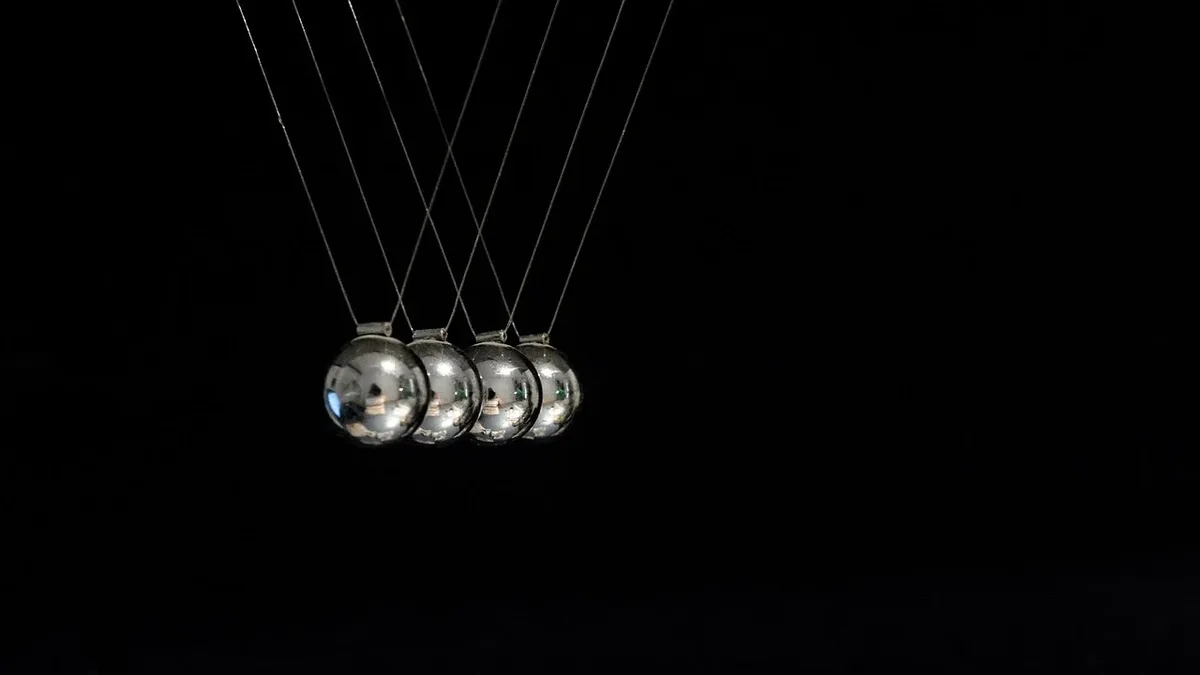
A quantum simulator built from 13 trapped ions has modeled string-breaking dynamics analogous to quark confinement in high-energy physics. The experiment simulated how energy accumulation leads to effective particle-antiparticle formation, offering a new way to study matter creation processes from the universe's first moments.
Precisely controlled laser beams tuned the interactions between the ions. Researchers prepared the quantum system in an out-of-equilibrium state and tracked its evolution over time. Effective charges emerged and the resulting dynamics were reconstructed with high fidelity. Classical computer simulations validated the quantum simulator's results, showing agreement at this scale.
Broader context and replication
The findings align with similar results from other teams using different quantum hardware. Groups from Google and QuEra Computing have replicated similar string-breaking models using superconducting circuits and neutral atoms, respectively. The successful replication of these dynamics across three distinct quantum platforms-trapped ions, superconducting circuits, and neutral atoms-bolsters confidence in the technique. The study joins two other recently published findings, collectively validating the use of quantum computers to simulate this fundamental phenomenon.
Implications and significance
The simulation recreated conditions mirroring the extreme energies present immediately after the Big Bang. It provides insight into the complex dynamics of particle creation, a process that occurred in the earliest moments of the universe and remains difficult to study directly. The ability to simulate these dynamics without relying on traditional high-energy particle colliders represents a significant advancement. As simulation complexity increases, computational demands will exceed the capabilities of even the most powerful conventional computers.
Research team and support
The research was led by Christopher Monroe, Gilhuly Family Presidential Distinguished Professor of Electrical and Computer Engineering and Physics at Duke University. The Duke Quantum Center led the international collaboration, which included the University of Maryland, Oxford University, Caltech, Cornell University, and KU Leuven. Zohreh Davoudi, associate professor of physics at UMD, was part of the team. Arinjoy De, first author on the paper, is a former PhD student from Monroe's lab now at QuEra Computing.
Funding came from multiple agencies, including the Department of Energy, National Science Foundation, Air Force Office of Scientific Research, Defense Advanced Research Projects Agency, and Amazon Web Services. Christopher Monroe highlighted the platform's potential, stating, "Quantum computer simulations provide the best platform to investigate complex questions like matter formation, short of having witnessed the Big Bang itself." Future experiments will rely exclusively on quantum processing power as simulation complexity increases beyond classical computer capabilities.