Belle Ii And Superkekb
| Experiment | Belle II experiment |
|---|---|
| Accelerator | SuperKEKB accelerator |
| Location | KEK laboratory, Tsukuba, Japan |
| Purpose | Study CP violation and rare decays of B mesons and other particles |
| Particle collisions | Electrons and positrons |
| Center-of-mass energy | 10.58 GeV (Υ(4S) resonance) |
| Luminosity design | ~6×10³⁵ cm⁻²s⁻¹ (world record target) |
Origin and history
Belle II is a particle physics experiment that began taking data in the 2010s, specifically from 2018 onward. Its predecessor, the Belle experiment, operated from 1999 to 2010 at the KEK laboratory in Tsukuba, Japan. The SuperKEKB particle accelerator is the upgraded collider that provides the particle beams for the Belle II experiment, also located at KEK. The upgrade project to create SuperKEKB and Belle II was formally initiated in the late 2000s following the conclusion of the original Belle and KEKB programs. This collaborative effort involves hundreds of scientists and engineers from dozens of countries and regions worldwide, though the host facility is in Japan. The design and construction phase spanned much of the 2010s, culminating in the first collisions in the Belle II detector in 2018.
What it is for
The primary purpose of the Belle II experiment and the SuperKEKB accelerator is to study the subtle differences between matter and antimatter, a phenomenon known as CP violation. It aims to probe the limitations of the Standard Model of particle physics by making extremely precise measurements of the properties and decays of B mesons, charm hadrons, and tau leptons. Researchers use it to search for signs of new, undiscovered particles or forces that are too heavy to be produced directly at the collider's energy but can influence decay rates and asymmetries. The experiment is specifically designed to investigate rare decays of these particles that are highly suppressed in the Standard Model, where any deviation from prediction would be a clear sign of new physics. Another key goal is to perform detailed studies of hadrons, including exotic states that do not fit the conventional quark model. The immense data set also allows for precision tests of quantum chromodynamics and searches for dark sector particles and light dark matter candidates.
Overview
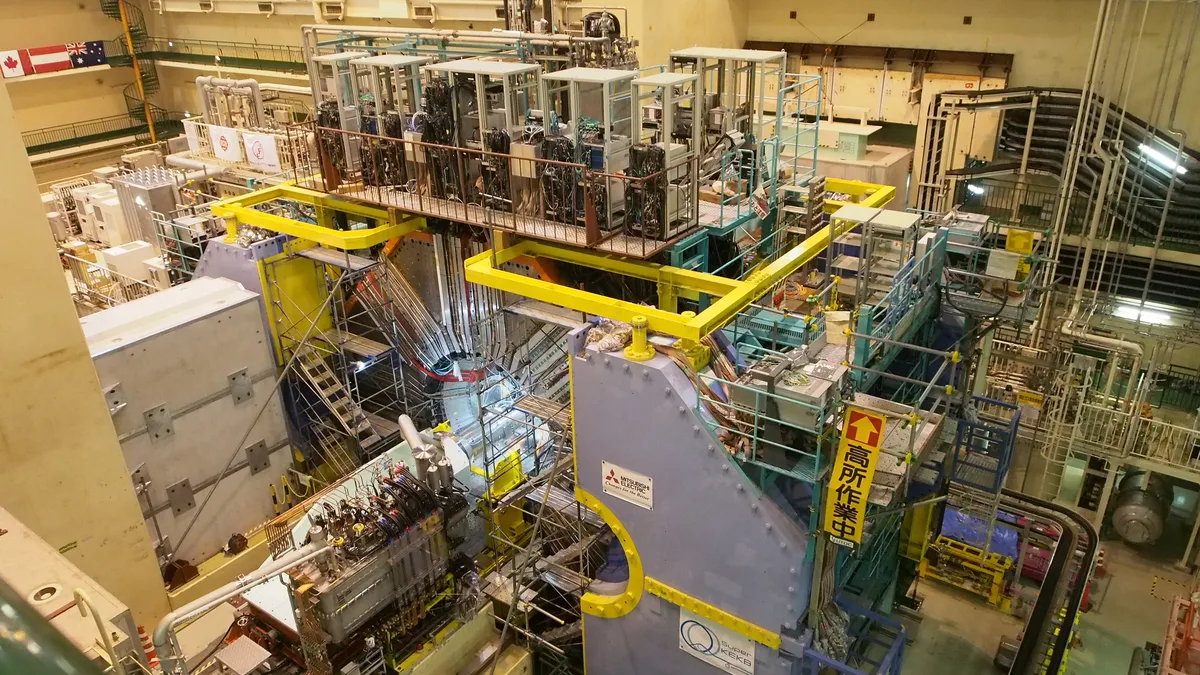
SuperKEKB is an asymmetric electron-positron collider, meaning it accelerates electrons and their antimatter counterparts, positrons, in opposite directions in two separate rings at different energies before colliding them. Its key innovation is the "nano-beam" scheme, which squeezes the particle beams to an unprecedented tiny size at the collision point to drastically increase the luminosity, or collision rate. The Belle II detector is a large, general-purpose particle detector surrounding the collision point of SuperKEKB, composed of multiple sub-detector layers. These layers include a silicon vertex detector, a central drift chamber, particle identification systems, an electromagnetic calorimeter, and a muon and neutral hadron detector, each designed to precisely measure the properties of particles produced in the collisions. The experiment is designed to collect a data sample, known as an integrated luminosity, that is about 50 times larger than its predecessor, enabling the study of extremely rare processes. The entire facility operates as a single integrated system where the accelerator performance directly defines the statistical power of the physics measurements made by the detector.
What to know
The particle collisions at SuperKEKB occur at a center-of-mass energy of 10.58 GeV, which corresponds to the mass of the Υ(4S) resonance, a particle that decays almost exclusively into pairs of B mesons and anti-B mesons. This "B-factory" configuration allows for the clean production and study of these particles in a quantum-coherent state. The term "asymmetric" refers to the different energies of the electron and positron beams, which gives the produced B meson pair a boost along the beam axis, enabling precise measurement of their decay vertices and time-dependent CP violation. The targeted peak luminosity of SuperKEKB is about 40 times higher than that of the previous KEKB machine, representing a world-record design value. Achieving and maintaining this extreme luminosity requires exceptional control and stability of the particle beams and places immense demands on the detector's ability to handle high event rates without becoming overwhelmed. The analysis of the data is highly complex, relying on sophisticated software frameworks and advanced statistical techniques to isolate the extremely rare signals from vast backgrounds.
Common questions
A common question is how Belle II differs from the LHC experiments, with the key distinction being that Belle II is a "precision frontier" experiment at lower energy studying specific particle decays in detail, while the LHC is an "energy frontier" machine colliding protons to directly produce new heavy particles. People often ask what "Belle" stands for, which is not an acronym but was chosen as a name evocative of beauty, referencing the "beauty quark" (or bottom quark) that is a primary subject of study. Many wonder if antimatter is dangerous, but the amounts produced in the collider are minuscule and annihilate instantly upon contact with ordinary matter, posing no macroscopic risk. A frequent technical question concerns how the detector can distinguish between different types of charged particles like pions, kaons, and protons, which is achieved through combined measurements from dedicated particle identification systems using Cherenkov radiation and time-of-flight information. Others ask why studying CP violation matters, with the fundamental answer being that the observed asymmetry between matter and antimatter in the universe is one of the greatest unsolved problems in physics and requires a source beyond the known Standard Model effects. Finally, there is often curiosity about the international collaboration, which is a large, decentralized scientific body where work is divided among groups specializing in detector subsystems, physics analysis, and accelerator operations.
Pros and cons
A major pro of the Belle II and SuperKEKB design is its unmatched potential luminosity for an electron-positron collider, which directly translates to the statistical power needed to observe exceedingly rare decay processes. The clean experimental environment of electron-positron collisions, compared to the messy proton-proton collisions at the LHC, allows for precise reconstruction of entire event kinematics with lower background. A significant con is the immense technical challenge and operational complexity of achieving and sustaining the designed nano-beam luminosity, where even minor instabilities can drastically reduce data collection efficiency. The experiment's narrow focus on the bottom and charm quark sectors, while a strength for precision, also means it is not a direct discovery machine for very high-mass new particles beyond its production energy threshold. A common point of regret or difficulty for researchers involves the intense competition within the collaboration for analysis resources and the long, complex path from raw data to a publishable physics result, which can be daunting for early-career scientists.
Who it suits
This research environment suits physicists and engineers who are deeply interested in precision measurements and indirect searches for new physics through quantum effects, rather than those focused on direct discovery at the highest energies. It is ideal for individuals who thrive in large, international collaborations where work is highly specialized, requiring experts in specific detector technologies, accelerator physics, software development, or statistical analysis. The project suits institutions and groups that can make long-term commitments, as the data-taking and analysis phases span decades, and contributions are measured over years, not months. It is well-suited for students and postdoctoral researchers who can immerse themselves in a specific sub-system or analysis topic, gaining deep expertise in handling complex datasets and systematic uncertainties. The work also suits theorists who specialize in flavor physics and the Standard Model's phenomenological extensions, as they rely on the experiment's results to constrain or guide their models. Finally, it appeals to those with a strong appreciation for the engineering marvel of particle accelerators and detectors, where operational excellence and continuous optimization are as crucial as the theoretical physics goals.