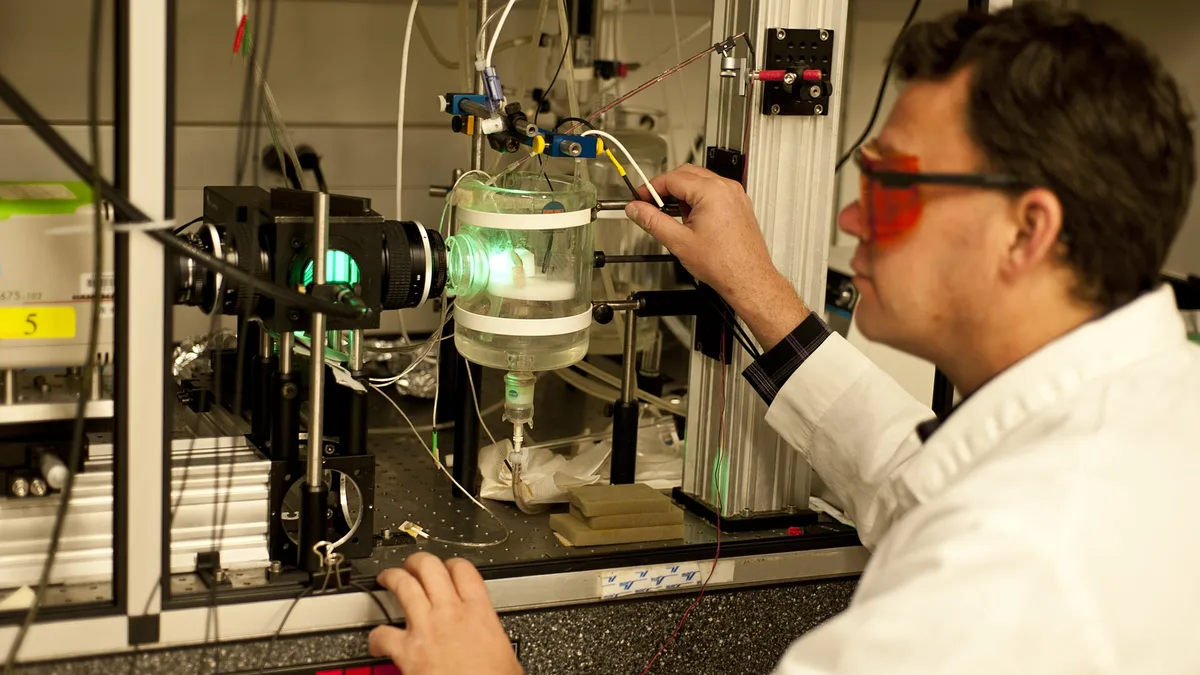
Biophysics
| Core discipline | Physics applied to biological systems |
|---|---|
| Recall method | Quantitative measurement and modeling of biological processes |
| Typical scale of study | Molecular to organismal |
| Key experimental tools | Microscopy, spectroscopy, computational simulation |
| Original use | Understanding physical principles underlying life |
| Primary subfields | Molecular biophysics, cellular biophysics, biomechanics |
| Common degree level | Doctoral (Ph.D.) |
Origin and history
Biophysics emerged as a distinct discipline in the mid-twentieth century, though its intellectual roots are far older. Its development is primarily associated with scientific advances in Europe and North America. The field crystallized from the convergence of physics, physiology, and biochemistry in the late 19th and early 20th centuries. Pioneering work by figures like Hermann von Helmholtz in Germany, who studied nerve impulses and vision, applied physical principles to biological systems. The invention of key instruments, such as the X-ray diffraction techniques used to study biological molecules, provided crucial methodological foundations. The establishment of dedicated departments and journals bearing the name "biophysics" in the 1950s marked its formal institutional recognition as a modern scientific field.
What it is for
Biophysics is fundamentally for understanding biological processes through the quantitative language and laws of physics. It seeks to explain how molecules, cells, and organisms function in terms of forces, energies, structures, and dynamics. A primary purpose is to determine the three-dimensional structures of biological macromolecules like proteins and nucleic acids, which is essential for understanding their function. It is used to model and predict complex biological systems, such as neural networks or the mechanics of cell division. The field provides the theoretical and experimental framework for developing medical technologies like magnetic resonance imaging (MRI) and therapeutic ultrasound. Furthermore, biophysics aims to uncover the physical principles underlying phenomena such as signal transduction, energy conversion, and molecular self-assembly.
Overview
Biophysics is an interdisciplinary science that applies the theories and methods of physics to study biological systems. It operates across a vast scale, from single molecules to whole organisms and ecosystems. Core approaches include using spectroscopy to probe molecular interactions, computational modeling to simulate dynamic processes, and force measurement techniques like optical tweezers to study mechanical properties. The field often focuses on quantitative measurement and mathematical modeling rather than purely descriptive biology. It bridges the gap between the molecular detail of biochemistry and the organizational principles of physiology. Key sub-disciplines include molecular biophysics, membrane biophysics, neurobiophysics, and systems biophysics, each with specialized techniques and focal questions.
What to know
A foundational concept is that biological systems obey the laws of thermodynamics, particularly regarding energy transfer and the drive toward entropy. Understanding the relationship between a macromolecule's structure and its function is a central tenet, often summarized as "structure determines function." Key quantitative skills include a strong grasp of mathematics, statistical mechanics, and computational methods for analyzing complex data. Knowledge of experimental techniques is critical, such as cryo-electron microscopy for structure determination, patch clamping for studying ion channels, and fluorescence resonance energy transfer (FRET) for measuring molecular distances. It is important to recognize that biophysical models are simplifications of vastly complex biological reality and have defined limitations. The field is inherently collaborative, requiring communication across the traditional boundaries of physics, chemistry, biology, and engineering.
Common questions
A common question is how biophysics differs from biochemistry, with the distinction lying in biophysics' emphasis on quantitative, physical measurement and theoretical modeling of biological form and function. Many ask what educational background is required, which typically involves strong foundations in both physics and biology, often at the graduate level. People frequently inquire about its medical applications, which range from the design of medical imaging devices to the development of targeted drug delivery systems based on molecular interactions. A recurring question concerns the role of computation, which is now indispensable for simulating molecular dynamics, analyzing large datasets, and predicting protein folding. Individuals often wonder if biophysics only studies large molecules, while in reality it also addresses larger-scale phenomena like hearing mechanics or cardiovascular fluid dynamics. Another typical question is about its contribution to understanding diseases, such as using biophysical principles to elucidate the molecular malfunctions in neurodegenerative conditions or cancer.
Pros and cons
A significant advantage of biophysics is its powerful capacity to provide mechanistic, quantitative explanations for biological phenomena that are otherwise descriptive. It drives technological innovation, leading to tools that revolutionize both research and medicine. However, a common con is the steep learning curve, requiring deep integration of two disparate knowledge domains, which can lead to frustration for students strong in only one area. A genuine drawback is that highly reductionist biophysical studies on isolated molecules or systems can sometimes lose sight of the integrated physiological context, leading to findings difficult to translate to whole organisms. Practitioners sometimes regret the heavy reliance on extremely expensive and complex instrumentation, which can limit experimental access and prioritize technique over biological question. The common mistake is attempting to apply overly simplistic physical models to inherently messy, evolved biological systems, resulting in elegant but biologically irrelevant conclusions.
Who it suits
This field suits individuals with a strong analytical mindset who are driven by fundamental "how" and "why" questions about living systems. It is ideal for those comfortable with mathematics and computational tools who wish to apply them to biological problems. Researchers who enjoy working at the interface of disciplines and collaborating with specialists from diverse backgrounds often thrive in biophysics. It suits experimentalists fascinated by sophisticated instrumentation and theorists dedicated to building predictive models of biological complexity. The field is not well-suited for those seeking purely descriptive biological research or who are uncomfortable with abstract quantitative reasoning. It appeals to problem-solvers aiming to bridge basic science with practical applications in biotechnology, medicine, and bioengineering.