Electrically driven molecular motor achieves controllable rotation
Scientists have created the first molecular motor driven by electrical current between two metal electrodes, achieving controllable rotation.
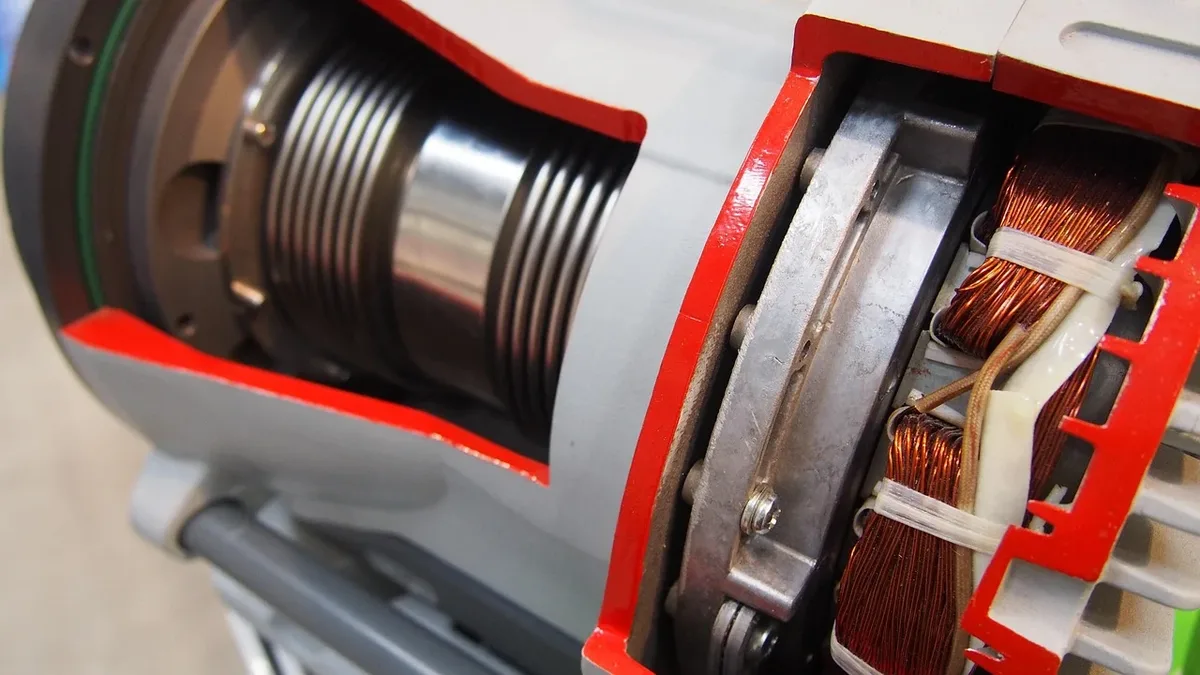
Researchers have built the first molecular motor driven by electrical current that achieves controllable rotation between two metal electrodes. The motor spins when electricity passes through it and can reverse direction by changing voltage polarity. Above a certain voltage, the rotation transitions into continuous motion. This new machine uses electrons flowing through a helical molecule to set it in rotation. Electric current generates directed rotation, which in turn controls current, representing a new operating principle at the limits of miniaturisation. Such machines offer new opportunities for researching physical processes on an atomic scale.
Archimedes screw-inspired molecular design enables rotation control
The motor's central component is a spiral molecule measuring a few millionths of a millimetre, created by Prof. Michael Pittelkow's group at the University of Copenhagen. This design was inspired by the ancient Archimedes screw, a water transport machine invented over 2,000 years ago. Electron flow transfers angular momentum to the molecule, driving rotation similar to wind driving a wind turbine. The direction of rotation was reversed by changing the polarity of the applied voltage.
Quantum simulations and experimental validation
Prof. Dr. Fabian Pauly and his PhD students Léon Martin and Yuta Ito used quantum mechanical simulations on the LiCCA supercomputer at the University of Augsburg. Per Hedegård from the Niels Bohr Institute and Jing-Tao Lü from Huazhong University of Science and Technology developed a theoretical model that reproduced experimental results. These simulations revealed the relationship between the molecule's rotation and its ability to carry electrical current. Researchers at the Weizmann Institute of Science, led by Prof. Oren Tal and Dr. Anil Kumar Singh, positioned the molecules between gold tips sharpened to atomic dimensions.
The work received funding from multiple sources.
| Funding Source | Details |
|---|---|
| German Research Foundation (DFG) | Collaborative Research Center (SFB) 1585 (project number 492723217) and LiCCA supercomputer (project number 499211671) |
| European Research Council (ERC) | Horizon 2020, Grant 864008 |
| Israel Science Foundation | Grant 2129/23 |
| Minerva Foundation | - |
| Villum Foundation | - |
| Novo Nordisk Foundation | - |
| Independent Research Fund Denmark (DFF) | - |
| National Key Research and Development Program of China | - |
| National Natural Science Foundation of China | - |
Enhanced conductivity through rotational dynamics
The rotating molecule conducted electricity up to 100 times more efficiently than when stationary. This increase in conductivity, up to two orders of magnitude, is due to rotation making highly conductive molecular positions accessible, which the molecule avoids when at rest. The molecule conducts electricity best when rotated, as rotation makes previously inaccessible positions available. The conductivity increase is linked to the molecule’s angle of rotation.
New operating principle for nanoscale machines
The motor converts electricity into directed rotation, with rotation controlling electrical current, introducing a new operating principle for nanoscale machines. Molecular motors powered directly by electric current have existed since 2011, but earlier designs operated only on surfaces using scanning tunnelling microscope tips. The new motor, which allows electrons to travel through a spiral-shaped molecule, enables potential applications in molecular electronics, spintronics, and microfluidic systems. Molecular machines are regarded as the next step in miniaturisation, a field recognised by the 2016 Nobel Prize in Chemistry. The work was published in Nature in 2026. The motor's ability to convert electrical current into directed rotation that controls electrical conductivity establishes a new operating principle for nanoscale machines.