Caltech chip steers light in 74 femtoseconds
A Caltech team has built a silicon metasurface device that uses one light beam to redirect another in just 74 quadrillionths of a second, a breakthrough
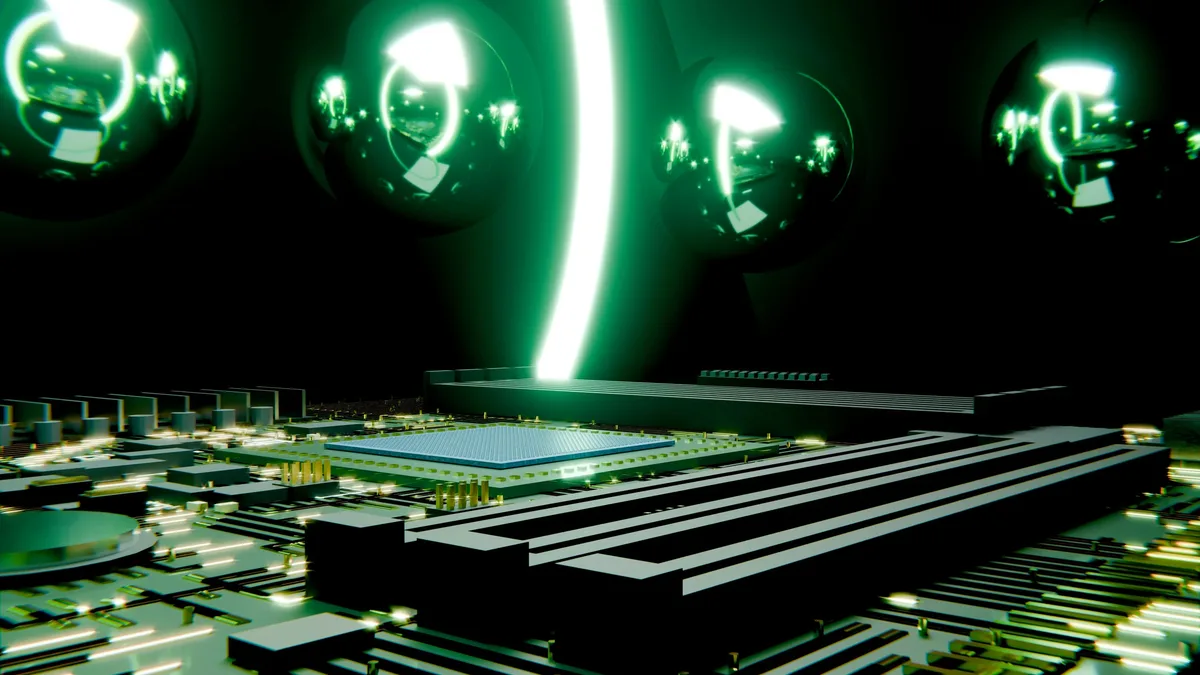
Caltech researchers have developed a device that redirects a beam of light in just 74 femtoseconds. The system uses a powerful pump beam to alter a nanoscale silicon metasurface, steering a second probe beam without any electrical signal.
According to the team, this all-optical steering is roughly the time it takes light to cross the width of a human hair. The work could enable dramatically faster photonic communications, computing, and sensing technologies. Lead author Claudio Hail conducted the research as a postdoctoral scholar in the lab of Harry Atwater, the Howard Hughes Professor of Applied Physics and Materials Science at Caltech.
The bottleneck in conventional methods
Many current technologies for controlling light rely on changing a material's electronic properties. In devices like liquid-crystal projectors or telecom optical chips, electrons are excited to higher energy states. Their subsequent relaxation back to lower states creates a delay, typically limiting modulation speeds to the nanosecond or picosecond range.
Harry Atwater explains the core challenge. "Steering light with light is very challenging because light typically interacts very weakly with matter," he says. The Caltech team's approach bypasses the electronic bottleneck entirely by using light to control light.
Harnessing the optical Kerr effect
The device operates on the optical Kerr effect. When an intense pump beam strikes a material, it can induce an extremely brief, minuscule change in the material's refractive index. This change stems from alterations in the motion of electrons within their atomic orbitals, not from pushing electrons into separate, long-lived excited states.
Consequently, the refractive index shift can appear and vanish almost as fast as the light pulse itself. There is no waiting period for electron relaxation. On its own, however, the Kerr effect is too weak to produce a useful deflection of a light beam.
A metasurface of silicon pillars
To amplify the effect, the researchers engineered a metasurface from a thin film of amorphous silicon. They patterned it with an array of nanoscale pillars, each smaller than the wavelength of the pump light.
The precise size and spacing of these pillars were designed to trap light, causing it to circulate within the metasurface slightly longer than it would in a plain film. This enhanced interaction time strengthened the small refractive index change in the silicon, making it substantial enough to steer the probe beam.
Using this design, the team demonstrated beam steering angles of up to 13 degrees. The 74-femtosecond modulation speed was found to be limited by the duration of the pump laser pulse itself.
Pushing toward faster limits
The researchers note that the current speed limit is set by their laser equipment, not by the fundamental physics of the meta-material. This suggests the process could be made even faster with shorter pump pulses.
Such advances could bring the technology into timescales relevant to new photonic concepts like time crystals and synthetic time-varying optical materials. The work was supported by the Air Force Office of Scientific Research, the Swiss National Science Foundation, the Fulbright Fellowship program, the Breakthrough Foundation, and Caltech's Kavli Nanoscience Institute.