Soft Microgels Stabilize Centimeter-Long Water Jets
Researchers at TU Darmstadt have shown that soft polymer particles called microgels can dramatically extend the stability of thin water jets generated by

Tiny, soft polymer particles can stabilize a centimeter-long water jet, a study from TU Darmstadt reveals. Published in Nature Communications on September 7, 2026, the research demonstrates how microgels-particles less than one micrometer in size-adsorb at an air-water interface to control jet breakup.
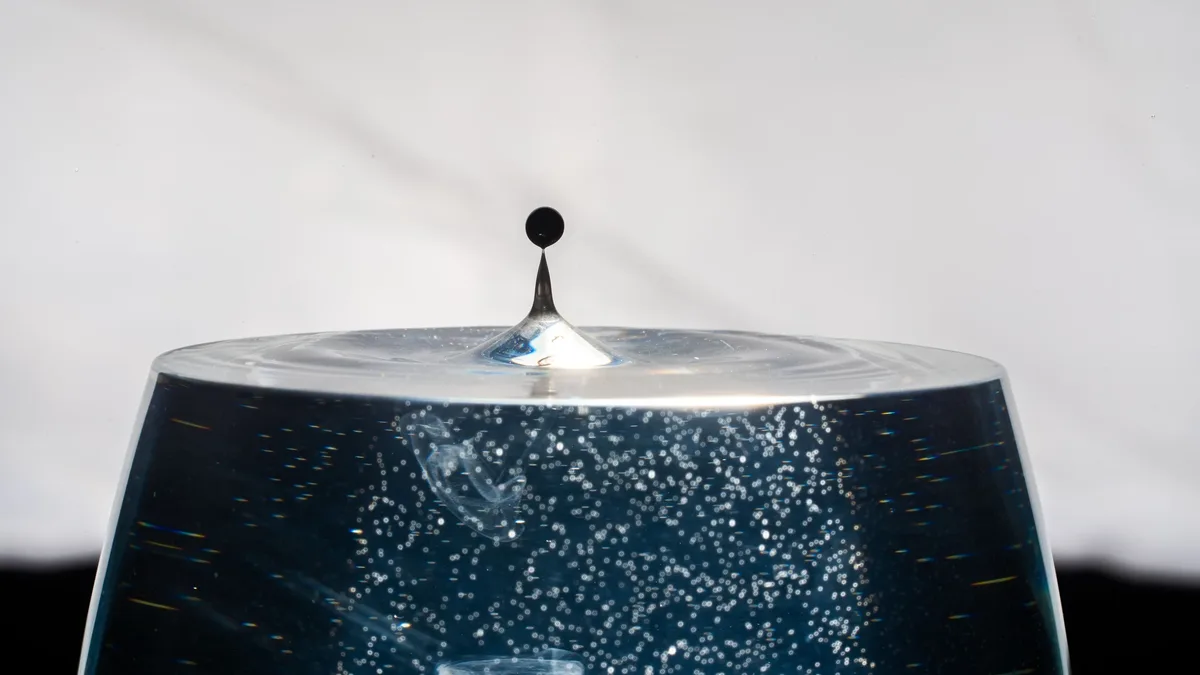
These microgels function similarly to conventional surfactants by reducing surface tension. However, the team notes they are nontoxic and operate through a distinct physical mechanism. For the experiment, scientists used a chip generating surface acoustic waves at about 64 MHz to produce a water jet roughly 200 micrometers in diameter from a droplet containing the microgels. A high-speed camera captured the process.
Dr. Amin Rahimzadeh from the Institute of Condensed Matter Physics at TU Darmstadt explained the surprising scale of the effect. "Although the microgels themselves are only around 700 nanometers in size, their properties can determine the stability of a liquid jet extending over a centimeter," he said. The key finding was that softer particles led to longer-lasting jets.
Particle Stiffness as a Key Factor
The stability depended critically on particle deformability. During synthesis, the researchers tailored microgel stiffness by modifying the cross-linking density of the polymer scaffold. A more cross-linked framework produced stiffer particles, while weaker cross-linking yielded softer ones.
Computer simulations provided the explanation. Dr. Suvendu Mandal, also from the Institute of Condensed Matter Physics, detailed the mechanism. At the interface, soft microgels stretch and deform readily, remaining connected to one another and maintaining low surface tension. Stiffer particles detach more easily, causing the jet to become unstable and break up sooner.
Experimental Setup and Observation
The experimental setup was designed by Dr. Andreas Winkler and Dr. Mehrzad Roudini from the Leibniz Institute for Solid State and Materials Research in Dresden. They described the observed effect as highly exciting and emphasized its potential for improving future technologies. First author Atieh Razavi highlighted the challenge of observation, noting the jetting process is too fast for the naked eye and requires a high-speed camera with resolution under a millisecond.
The following table summarizes key experimental parameters from the study:
| Parameter | Specification |
|---|---|
| Microgel Size | ~700 nanometers |
| Acoustic Wave Frequency | ~64 MHz |
| Jet Diameter | ~200 micrometers |
| Jet Length | Over a centimeter |
| Camera Resolution Required | Less than 1 millisecond |
Potential Applications and Significance
The researchers see immediate potential in needle-free drug delivery systems, where thin, fast liquid jets administer medicine through the skin. Better jet control could make such systems more reliable, potentially reducing invasive injections and medical waste from disposable needles. The findings may also be relevant for inkjet printing.
Professor Regine von Klitzing showed the significance of moving microgel research from fundamental studies toward practical applications. Professor Benno Liebchen from TU Darmstadt highlighted the role of theoretical modeling. "The simulations reveal a mechanism by which nanoscale interactions create a safety net that protects soft interfaces against breakup-even in a centimeter-long jet," he explained. The team is now interested in optimizing the acoustic transducers and electrical signaling for more precise controlled systems.