Soft nanoscale confinement reveals water's
Researchers used soft nanoconfinement in phytantriol membranes to prevent ice formation and observe water's transition to a glassy state across a wider
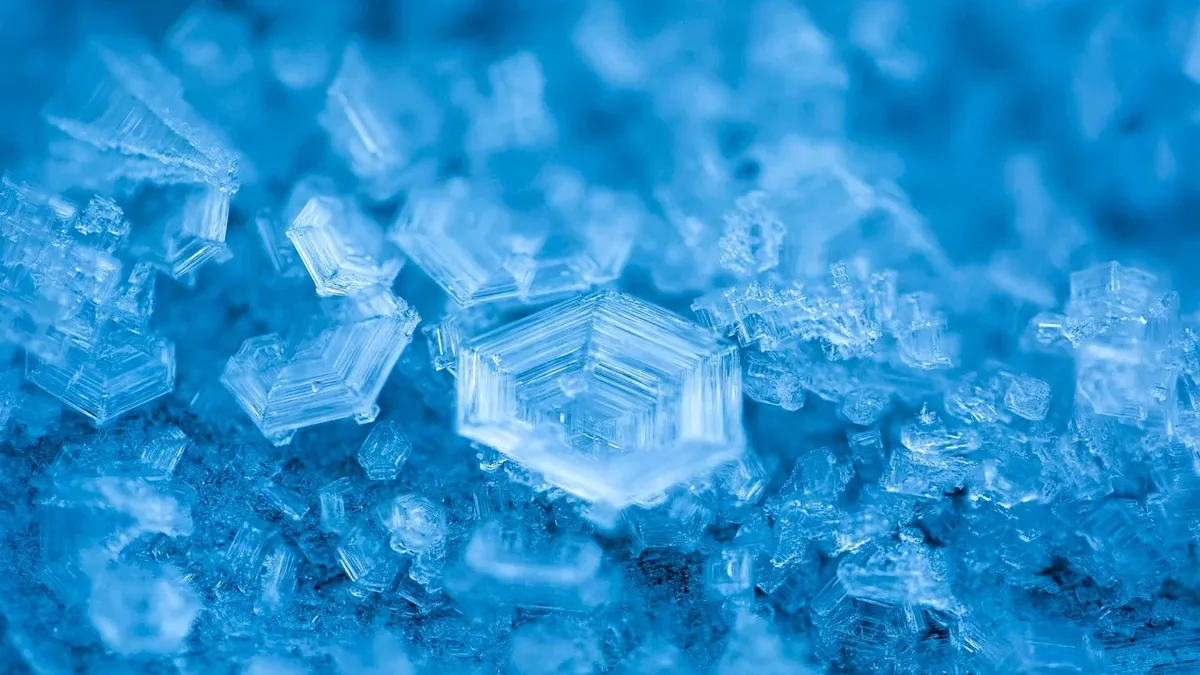
An international team of researchers has used ANSTO's facilities to study water under soft nanoscale confinement, uncovering new insights into its liquid-to-glass transition. By trapping tiny amounts of water within lipid-like membranes made of phytantriol, they prevented crystallization into ice and accessed a previously hidden glassy state. This approach allowed observation of the transition over a broader temperature range than seen in bulk water.
X-ray data mapped the structure
Experiments on the SAXS/WAXS beamline at the Australian Synchrotron were essential for characterizing the structure of phytantriol-water mixtures. Researchers directly observed water remaining confined in nanoscale layers at temperatures well below its normal freezing point. These measurements provided the structural basis for investigating the liquid-to-glass transition. Dr. Patrick Züblin of Monash University collaborated with the SAXS/WAXS team to optimize low-temperature measurements down to -120°C (-184°F), as noted by Dr. Ashish Sethi, beamline group manager.
Neutrons tracked hydrogen motion
The team used the Emu and Pelican instruments at the Australian Centre for Neutron Scattering to study water's molecular dynamics. Because neutrons are highly sensitive to hydrogen, they enabled direct tracking of water molecule movement. The data showed that water's dynamics slowed significantly between -35°C (-31°F) and -20°C (-4°F), indicating the onset of glassy behavior. Dr. Alice Klapproth, principal instrument scientist, explained that the neutron signal is dominated by hydrogen motions in water, allowing selective measurement even in complex soft matrices.
Separating water from its surroundings
Neutron scattering, combined with deuteration at the National Deuteration Facility, allowed researchers to isolate water's behavior from the surrounding lipid material. In the confined state, water became glassy while the phytantriol membranes remained mobile and fluid. This separation was critical for confirming that the observed transition belonged to water alone. The study also incorporated measurements from the Soleil Synchrotron in France, low-temperature microscopy, nuclear magnetic resonance spectroscopy, and computer simulations to support the findings.
The results, published in Nature Communications, have implications for cryopreservation, food-freezing technologies, and understanding water in living cells where nanoscale confinement is common. The work resolves a long-standing challenge in observing water's liquid-to-glass transition, which is typically obscured by rapid ice crystallization.