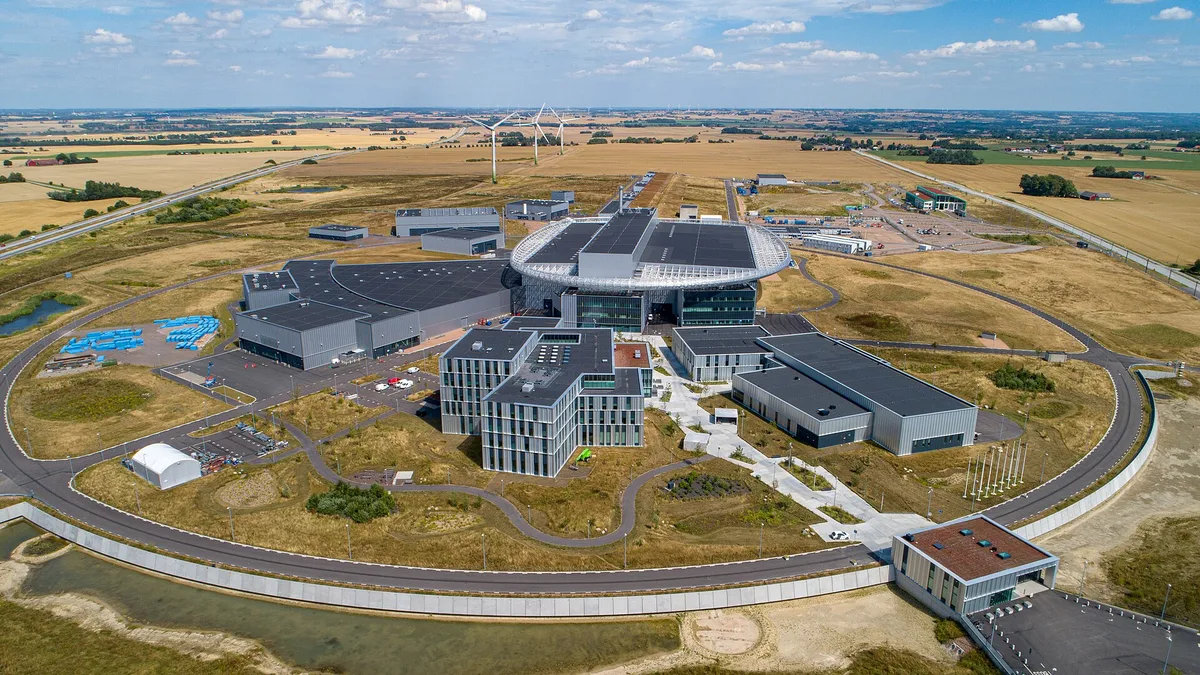
China Spallation Neutron Source
| Site context | Large-scale scientific facility for neutron scattering research |
|---|---|
| Original use | Multi-disciplinary research platform using neutron scattering |
| First created | 2018 |
| Country of origin | China |
| Location | Dongguan, Guangdong province |
| Primary particle | Proton |
| Target material | Tungsten |
| Neutron production method | Spallation |
Origin and history
The China Spallation Neutron Source (CSNS) is a major national scientific infrastructure project originating in the People's Republic of China. Its initial proposal and extensive planning phase occurred throughout the first decade of the 21st century. The project received official government approval in the late 2000s, marking the start of its construction phase. The site for the facility was selected in Dongguan, Guangdong province, a location chosen for its scientific and economic synergy with the Greater Bay Area. Construction of the complex began in the early 2010s, involving a multi-year effort to build the accelerator, target station, and initial suite of neutron instruments. The facility achieved its first proton beam on target in the late 2010s, officially commencing its user operation and opening to the global scientific community around that time.
What it is for
The China Spallation Neutron Source is designed to generate intense beams of neutrons for use as a probe in scientific and industrial research. Its primary purpose is to serve as a powerful tool for investigating the atomic structure and dynamics of materials. Researchers use the neutrons produced by CSNS to study condensed matter physics, chemistry, materials science, and biology at the molecular and atomic scale. The facility enables experiments that are impossible or impractical with laboratory-based sources, such as determining the positions of light atoms like hydrogen in complex molecules. It supports fundamental research into new materials, including batteries, superconductors, and polymers, by revealing how their internal structures change under different conditions. Furthermore, it provides critical analytical capabilities for industrial research and development, helping to solve applied problems in engineering and technology.
Overview
The China Spallation Neutron Source is a large-scale, user-facility that operates on the principle of spallation, where high-energy protons are fired at a heavy metal target to "knock out" neutrons. The facility consists of a linear accelerator (linac) that accelerates protons to high energies, followed by a rapid cycling synchrotron that boosts them further before they strike a tungsten target. The resulting neutrons are then moderated, or slowed down, to useful energies and guided through beamlines to various experimental stations, known as spectrometers or diffractometers. Each instrument is specialized for a different type of measurement, such as powder diffraction, small-angle scattering, or inelastic scattering. As a user facility, CSNS allocates beam time through a competitive peer-review process, where scientists from universities, research institutes, and companies propose experiments. The operation of such a facility is continuous, involving large teams for accelerator maintenance, instrument support, and user services.
What to know
The CSNS is one of only a few spallation neutron sources in the world, placing it in a category with facilities like ISIS in the UK and the SNS in the United States, though its design and capabilities are tailored to its specific scientific goals. Neutrons are uniquely penetrating and electrically neutral probes, allowing them to see deep inside materials and interact directly with atomic nuclei, making them sensitive to light elements. The brightness and pulse structure of a spallation source like CSNS enable time-of-flight experiments, where the energy of a neutron is determined by its speed over a known flight path. Using the facility requires specialized knowledge in neutron scattering techniques, and proposals must clearly articulate the scientific question and why neutrons are essential to answer it. The data produced is complex and requires significant expertise to model, analyze, and interpret correctly. Access is not instantaneous; successful proposals are scheduled into specific run cycles, and users must travel to the facility to conduct their experiments, often collaborating with the instrument scientists on site.
Common questions
A common question is how CSNS differs from a reactor-based neutron source, with the key distinction being that spallation sources use an accelerator to produce neutrons in pulses, while reactors provide a steady, continuous neutron flux. People often ask what types of samples can be studied, which range from powders and single crystals to liquids, gels, and engineering components, but samples must be prepared to specific size and environmental requirements. Researchers frequently inquire about the feasibility of studying radioactive or toxic materials, which is possible with proper containment but subject to stringent safety approvals. Many want to know if they can use the facility remotely, and while some aspects of data collection are increasingly automated, physical presence for sample mounting and instrument alignment is typically required. A recurring question concerns the cost of access, which for academic researchers conducting non-proprietary research is generally covered by the facility, with users responsible for their own travel and sample preparation expenses. Users also commonly ask about data ownership and publication policies, which are governed by facility guidelines that typically require acknowledgment and timely public release of results.
Pros and cons
The pulsed nature of the source and its modern instrument suite offer high performance for specific types of experiments, particularly those benefiting from time-of-flight methods. However, a major con is the intense competition for beam time, where even scientifically excellent proposals may be declined due to limited instrument availability, leading to significant delays in research progress. The complexity of neutron experiments means that inexperienced users can easily collect poor-quality data if not adequately supported, wasting precious beam time. Furthermore, the high cost of construction and operation of such a facility raises ongoing questions about funding sustainability and the balance between basic research and applied industrial use. A common mistake for new users is underestimating the time required for sample preparation and characterization prior to the beamtime, which can render the scheduled experiment ineffective.
Who it suits
The China Spallation Neutron Source suits research teams with a strong background in materials characterization who have a specific scientific question that can only be answered by neutron scattering. It is ideal for academic researchers and doctoral students in physics, chemistry, materials science, and engineering who are investigating the fundamental structure-property relationships in new or existing materials. Industrial research and development teams from sectors like advanced manufacturing, energy storage, and pharmaceuticals may find it valuable for solving specific analytical problems related to product formulation or failure analysis. The facility also suits instrument scientists and engineers who specialize in the development of new neutron scattering techniques or detector technology. It is less suited for researchers seeking quick, routine analytical results or those whose questions can be adequately answered with laboratory-based techniques like X-ray diffraction or electron microscopy. Successful users typically have prior experience with large-scale facility operations or are collaborating closely with experts who do.
Latest China Spallation Neutron Source news
Latest reporting

Space Station and Lab Tests Confirm Einstein's Equivalence
A quantum test on the China Space Station achieved record precision for the weak equivalence principle, while a separate lab experiment confirmed the
Spinon to Triplon Transition Observed in Frustrated Quantum
Neutron spectroscopy reveals a quasiparticle energy crossover from deconfined spinons to bound triplons in the spin-Peierls material CuGeO3, driven by

UrQMD Model Reveals Neutron Origin of Stopped Protons
A microscopic transport model study shows a significant fraction of protons stopped at mid-rapidity in low-energy heavy-ion collisions originate from

First Measurement of J/ψ Photoproduction on Neutron
Physicists report the first measurement of near-threshold J/ψ particle production from a neutron target, enabling a direct comparison with bound...

HERA Data Constrain Pion Structure via Leading Neutrons
A new analysis of leading-neutron production data from the HERA collider uses the Sullivan process and target-fragmentation modeling to constrain the

New fuel cell breakthrough could help power energy-hungry data centers
Researchers at Washington University in St. Louis have developed a new ultra-durable fuel-cell catalyst that could help turn hydrogen into a more...