Atom Interferometer on Space Station Tests Weak Equivalence
A team led by Ming-Sheng Zhan has conducted the first atom-interferometry test of the weak equivalence principle in space, using two rubidium isotopes
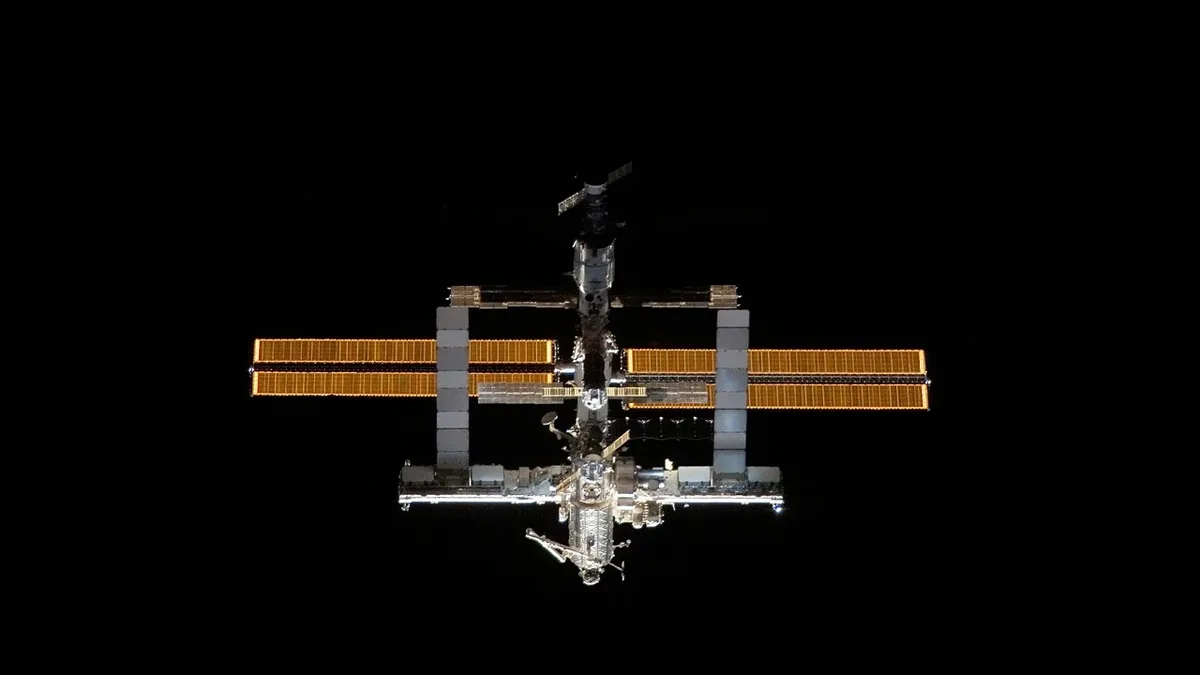
For the first time, physicists have tested the weak equivalence principle using clouds of continuously free-falling atoms aboard an orbiting space station. The experiment, led by Ming-Sheng Zhan of the Wuhan Institute of Physics and Mathematics, was conducted on the China Space Station and published in the journal Science Advances.
This principle is a cornerstone of Einstein's general relativity. It states that gravity accelerates all objects equally, regardless of their composition. This equivalence between gravitational mass and inertial mass means everything falls the same way in a gravitational field.
Searching for a Quantum Breakdown
For over a century, experiments have sought to find a violation of this principle. Earth-based tests have reached precisions of 1 part in 10 trillion. Space-based tests using metal test masses have pushed even further. Yet, many physicists suspect the weak equivalence principle might break down at quantum scales. Finding such a violation could provide important evidence for a theory of quantum gravity.
Testing with atoms probes the quantum area directly. Atom-based experiments search for subtle violations invisible to classical tests.
A Microgravity Laboratory
The China Space Station provided a unique platform. In orbit, the station and everything inside it exist in a state of permanent free fall, or microgravity. Zhan's team cooled clouds of two rubidium isotopes to near absolute zero and let them fall freely inside specialized chambers.
They used a technique called atom interferometry. A sequence of laser pulses split each atomic cloud into a superposition of two paths before recombining them. This allowed the team to measure each isotope's acceleration with extreme sensitivity. The continuous free-fall environment meant the atoms could be observed for much longer than is possible in any ground-based lab.
Results and Future Precision
Data were collected. The two rubidium isotopes were found to accelerate identically to within about 5 parts in 100 million. This result is three orders of magnitude more precise than any previous atom-based test conducted in microgravity. Once again, the weak equivalence principle held firm.
While not the most precise test the experiment sets new boundaries for where new physics might be hiding. The table below compares the precision of this new test with previous atom-based microgravity experiments.
Future missions aim to push this precision further. Longer free-fall times, quieter platforms, and more sensitive detection could close in on the scales where effects from dark matter or quantum gravity might finally reveal a crack in the principle's century-long record.